NIFT, Kangra
Feeling First is a research-driven socio-emotional learning toolkit designed to support emotional regulation among children aged 3–6. The project investigates how young children experience and respond to emotionally intense moments within diverse ECCE classrooms. Through literature review, teacher interviews and classroom observations, the project explored co-regulation, emotional expression and everyday classroom practices. The resulting toolkit combines tangible objects, visual prompts, activities and guided routines to create accessible, repeatable opportunities for children to experience emotional settling through shared classroom interactions.
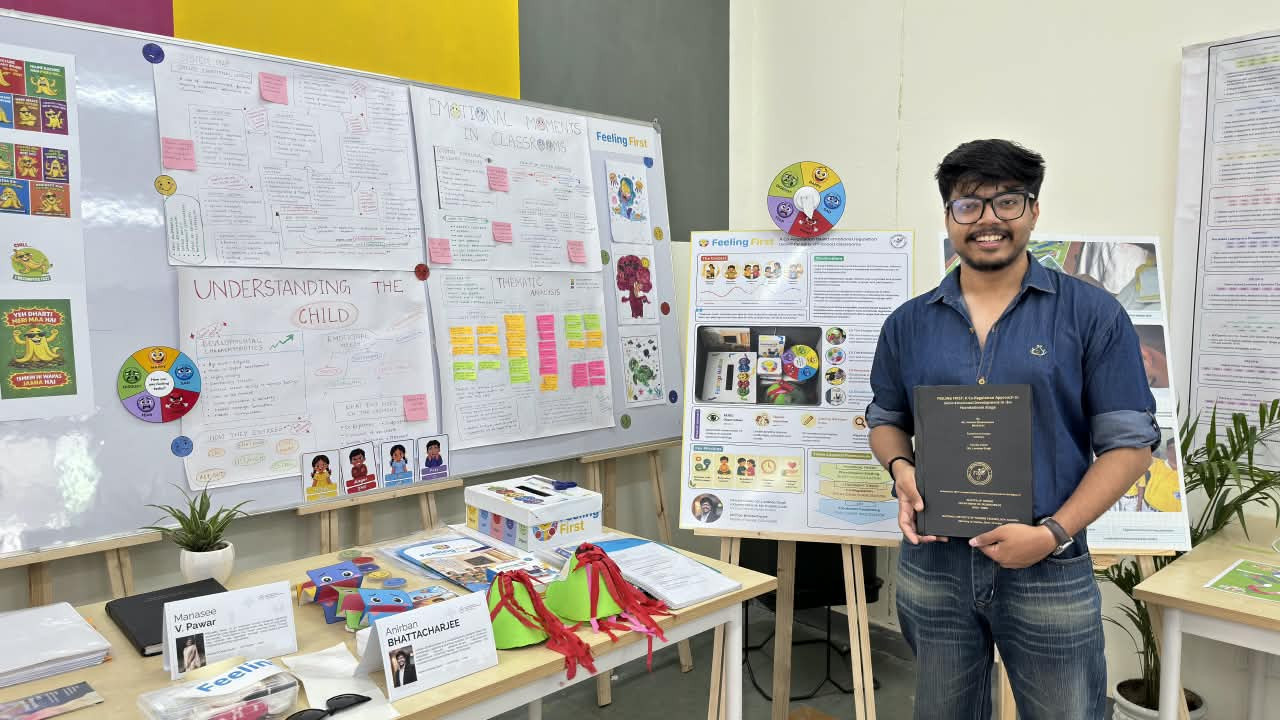
Feeling First is a research-driven experience design project exploring how emotional regulation can be supported among children aged 3–6 within Early Childhood Care and Education (ECCE) classrooms.
The project began with a broad investigation of socio-emotional learning, early childhood development and existing SEL frameworks before narrowing its focus towards emotion regulation and co-regulation.
Secondary research examined academic literature, frameworks, interventions and case studies related to early childhood emotional development.
This was followed by qualitative primary research involving educators across private, public, MCD, Anganwadi and Air Force school contexts, along with classroom observations and mapping of daily routines and emotionally intense moments.
The research indicated that young children frequently rely on adult-supported co-regulation, particularly during moments such as separation, transitions, peer conflict, fatigue and frustration.
Existing classroom responses often depend on verbal instruction, distraction or individually improvised strategies, with limited access to tangible regulation supports.
These findings informed the development of Feeling First, a child-facing toolkit intended to support shared emotional regulation through tangible interaction, visual communication, sensory engagement, play and repeatable classroom practices. Rather than treating regulation as a one-time activity, the project explores how supportive experiences can become part of everyday classroom life.
NIFT Assistant
Online — Ready to help
AI